
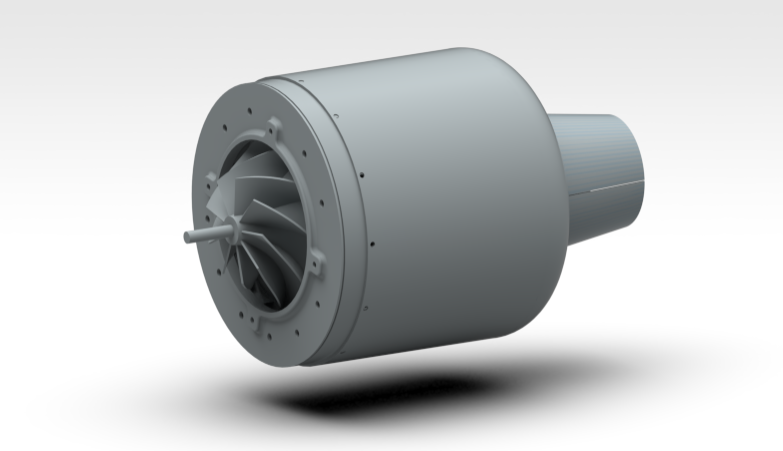
Small Scale Jet Engine Design
A complete CAD model and technical drawings were developed for a functional miniature turbojet, including compressor, turbine, combustor, and shaft assembly. The project showcases expertise in complex system integration, precision tolerancing, and design for manufacturability, demonstrating capabilities directly applicable to aerospace and high-performance engineering projects.
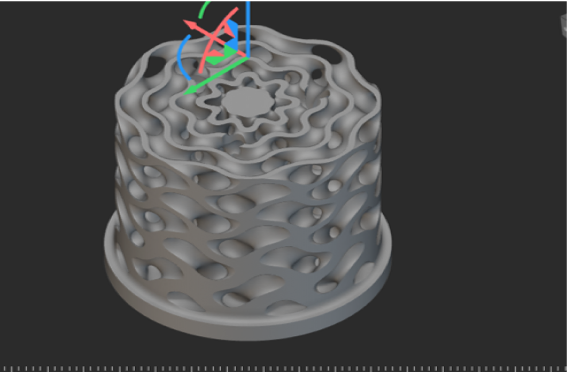
Gyroid Structured Heat Sink
A lightweight heat sink was designed using nTopology’s lattice and gyroid optimization tools, tailored for additive manufacturing in metal. The design maximizes surface area for efficient heat dissipation while minimizing material usage, offering a high-performance solution for thermal management. Applications include aerospace avionics, automotive electronics, and next-generation consumer devices where weight reduction and cooling efficiency are critical.

Topology Optimized Drone Frame
A lightweight, protective enclosure was developed for drone electronics using Siemens NX topology optimization and additive manufacturing principles. The design achieves significant weight reduction while maintaining structural stiffness, vibration resistance, and printability on conventional 3D printers. Applications include commercial and industrial drones, UAV prototyping, and aerospace research platforms where optimized weight, durability, and manufacturability are essential.

Airplane Wing Simulation
A complete structural and thermal analysis of an aircraft wing was conducted using MATLAB, incorporating static, dynamic, and thermal load cases. The project demonstrates the ability to predict stress distribution, deformation, vibration modes, and temperature effects on complex aerospace structures. Applications include aircraft component design, UAV development, and aerodynamic research where integrated multiphysics analysis and performance validation are critical.
Design of 4 DOF Decoupled manipulator
The project involved the design of a 4-DOF mechanical manipulator engineered for precise and repeatable movements with micrometer-level accuracy. A key focus of the design was the decoupling of degrees of freedom, ensuring that motion along one axis did not interfere with others, which enhances both control and measurement reliability. The manipulator was integrated with a dedicated measurement setup, carefully designed to maintain an independent metrology loop and consistent reference points for part alignment. This combination of mechanical precision and thoughtful metrology integration allows for highly accurate testing and characterization, making the system robust, versatile, and suitable for rigorous engineering applications.
Design of stiffness test setup
The project focused on the design of a mechanical test setup for accurately measuring the stiffness of locking pins under high loads. The setup was engineered with decoupled force and metrology loops to ensure highly precise and repeatable measurements, minimizing interference between applied forces and measurement sensors. It was designed to accommodate multiple testing positions within the same apparatus, allowing versatile evaluation without reconfiguring the system. A load cell was integrated to capture force data, while the overall mechanical design prioritized rigidity and stability to maintain measurement fidelity even under high loads. The result is a robust, reliable platform that supports consistent testing and thorough characterization of locking pin stiffness.
Design of 3D printed Electrode
The project focused on the design and manufacture of metal 3D-printed electrodes for green hydrogen production, balancing mechanical constraints with functional performance. The design process prioritized maximizing the effective surface area within a fixed volume, using lattice structures of varying sizes to enhance electrochemical activity while maintaining electrical conductivity. The manufacturing workflow leveraged metal additive techniques to accurately realize complex geometries, ensuring structural integrity and precision. This integrated approach—combining careful mechanical design with advanced manufacturing—produced robust electrodes optimized for efficiency and repeatability, demonstrating a practical pathway for high-performance green hydrogen production.